|
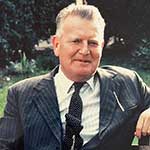
Colonel Malcolm Havergal CVO OBE
Late Coldstream Guards
by Major Sir Edward Crofton Bt
Formerly Coldstream Guards
|
Malcolm Havergal was born in Edinburgh on 10th May 1934, the eldest of two sons of Henry and Hyacinth Havergal. Henry was at the time a music master at Harrow School, and Hyacinth was a member of the Chitty Family, a lineage of which Malcolm was immensely proud, one of whom had served in the Coldstream.
The Havergals lived at Harrow but were evacuated to Thornthwaite in Cumbria at the beginning of the Second World War, and remained there for the duration. This period was a very important part of Malcolm’s life, and, until recently, he had often returned to see and meet up with old friends. Heharristtended St George’s School at Windsor Castle, a preparatory school for choristers at St George’s Chapel which also entailed the fatigue of having to stay behind at Christmas for the various Services, and to sing madrigals with The Royal Family at the Castle. After the War, the family moved back to Harrow, where Malcolm went to school and where he played Rugby in the XV. At the same time, his strong baritone voice marked him out and led to him being a soloist at The Late Queen’s Wedding in 1947 and when Winston Churchill visited the School.
In 1953, after Brigade Squad and Eaton Hall he was granted a National Service Commission in the Regiment. Thereafter his early career was rather typical of its time with postings hither and thither. Initially posted to the 2nd Battalion, then in Hubbelrath, West Germany, he was involved in the seemingly endless cycle of training which dominated life in the British Army of the Rhine (BAOR). In 1955 he was granted a Regular Commission and was posted to the 3rd Battalion, where he served until it was placed in suspended animation in 1959 and taking part in the Battalion’s final Queen’s Birthday Parade as Subaltern of The Escort. He also saw service with the Guards Parachute Company, was Military Assistant to Air Officer Commanding 38 Group RAF at RAF Odiham and was Second in Command of Number 1 Company, 2nd Battalion with whom he deployed on operations to Aden where fleetingly Malcolm found himself a Prison Governor and from where he deployed to Mauritius to deal with a State of Emergency. He remained in the Battalion on promotion to Major commanding a company until 1969 when he was posted to Headquarters Far East Land Forces. There he helped plan and oversee the withdrawal of the British Army from Malaysia and Singapore before becoming the Second in Command of the Guards Depot in 1972 and then Regimental Adjutant.
On promotion to Lieutenant Colonel, and after a couple of years in the at the Ministry of Defence, he took Command of the 2nd Battalion in 1976 on a residential tour in Londonderry with vast AOR which also included parts of County Tyrone and a very hostile and divided community. Against the backdrop of a very cold, wet and white winter, the Battalion successfully navigated ambushes, strikes, a visit by The Queen, finds and criminal arrests. It was a good tour and Malcolm, who, as one of his officers later told me, had the great gift of letting them get on with their jobs, was awarded an OBE. The Battalion returned to Windsor, for his final year in command.
Malcolm then embarked on a five-year period of duty with the Sultanate of Oman. From 1979-81, he was Army Member of the Joint Staff of the Sultanate Ministry of Defence, before moving to be Military Assistant to the Chief of the Defence Staff and Deputy Commander in Chief, Sultanate of Oman, General Sir Timothy Creasey. He was well suited to running a private office and enjoyed the diplomatic and financial vagaries of Omani Defence Policy. For his Service there, he was awarded the Sultan’s Commendation Medal in 1983.
In 1984 he was promoted Colonel and was appointed Regimental Lieutenant Colonel of the Regiment. He commanded The Queen’s Birthday Parade of 1985, when, ‘down below’, I had the privilege of commanding The Escort. His final appointment in the Army before his retirement in 1989, was as Chief of Staff, Headquarters London District.
In 1956 he met Fiona Fender, a niece of PGH Fender, who had been Captain of Surrey County Cricket Club, and had played 13 times for England. Despite some initial parental reluctance on her side and Army policy on the other, they married on 20th June 1959 and embarked on 66 years of a blissfully happy marriage, including two children, Arthur, who was tragically killed in an aircraft accident in South Africa aged 28, and Louise. Fiona embraced wholeheartedly her role as a military wife and they were a formidable team, and none more so than when Malcolm commanded the 2nd Battalion in Northern Ireland. When they arrived at Hindon in 1989, on his retirement from the Army, it was their 30th move in 29 years!
For Malcolm, retirement proceeded apace. Regimentally he involved himself in events for the next 25 years, and particularly those of The Coldstream Guards Association, of which he was a Vice President, and the Nulli Secundus Club. Outside of the Regiment, he was Chairman of the Army Benevolent Fund in Wiltshire for nine years, and a Deputy Lieutenant for that County. He was a Gentleman Usher for 13 years, which involved him in many State Occasions and Royal Duties. For this Service he was made a Commander of the Royal Victorian Order in 2004.
Meanwhile, he and Fiona were both involved in the local shoot, with Fiona acting as keeper, and he used to look forward to his annual fishing trips on the Spey with Ian Jardine, his former Commanding Officer, and also in Scotland with Johnny Clavering’s party. In ‘The Clubhouse’ after the day’s activity, the men did the washing up in the evening, with Malcolm leading the singing, accompanied by anyone who wished to join in! Mention should also be made of his prowess on the Cresta Run in St Moritz. In February 1969, in practice, he produced the fastest time of 26 competitors at Junction, and four consistently impressive times from Top. Thereafter, the Cresta Badge took pride of place on the front of his car!
There is no doubt, though, that cricket was his greatest passion. He was Secretary of I Zingari from 1993 to 2011, and the current Secretary recalls him being ‘seemingly ever present at I Z matters for over 30 years.’ However, it was the Guards Cricket Club which occupied pride of place in Malcolm’s sporting categories. His loyalty to the Club was unchallenged and unwavering, and he was its backbone in the 60s and 70s, appearing regularly at Burton Court either as a player, or, in later years, as Chairman. On the playing field he was an ‘honest journeyman’, who worked very hard and is particularly remembered for a short bowling run-up. He was also a pillar of the Club tour to Jersey for many years, where he would meet old friends, several of whom were Coldstreamers, together with their families. He and I travelled to Jersey from Munster in 1968, and stayed overnight at Valenciennes, prior to taking the ferry from St Malo. We parked in the Square and looked for a place to dine. We passed a restaurant where two Roman Catholic priests were eating. Knowing their partiality for good food, I suggested that we also ate there. He declined, and so we had a filthy dinner nearby! It was also in that year that he was given out ‘Handled the Ball’. He strode from the wicket, saying not a word, but looking like thunder!
Malcolm was a man of great presence and infinite charm, who will be remembered for many reasons, not least for his humanity and loyal Service to his Country, his Regiment, and, above all, his devotion to, and pride in, his family, together with the gratitude, kindness and perfect manners that he showed to so many. A tribute to his kindness comes from his barber:
I have been cutting Colonel Havergal’s hair for over 20 years. When Covid started, I had to close the business. During the first week I went to the shop and found a brown envelope with £15 inside from Colonel Havergal. I rang him up to thank him and said please don’t think you have to do that. Every third week throughout Covid the same brown envelope appeared with the £15 inside, on the day that I always cut his hair. He was one of the finest gentlemen I ever met.
On a personal note, I was a newly commissioned officer in the 2nd Battalion at Pirbright, and just about to depart with a Coldstream Platoon for an operational tour in Borneo, attached to Number 9 Company, Irish Guards in 1st Battalion Scots Guards. Just before lunch in the Mess, Malcolm, who was a Major in the Battalion, came over and wished me well, saying ‘we shall look forward to seeing you when you get back’. He needn’t have bothered. But that was Malcolm. I have always remembered that kindness, which was so typical of him.
On 28th May this year, Malcolm accompanied by Fiona and Louise, attended a very special Reunion Lunch of the 2nd Battalion at the Cavalry and Guards Club. 30 of his Officers were present, together with a number of the Wives. The occasion was a ‘thank you’ for everything that they had both done to make what had been a difficult time so enjoyable, and the vein of speeches, referring to them both, reflected that feeling. Louise has said that in spite of their indifferent health, they were determined to attend the event. Maybe they had an inkling that it would be their last opportunity to be part of a Coldstream gathering.
Malcolm died on 20th June, and Fiona a few days later on 3rd July and had a joint funeral at St John the Baptist Church, Hindon, on 17th July, where they were also buried. They will be remembered as stalwarts of the Coldstream Family. Our sympathy and thoughts go out to their daughter, Louise, and her children, Rosie, Rory and Billy, and grandson, Finn. |
|